9th Class Subject Wise Preparation Plan: A Complete Study Guide for Students

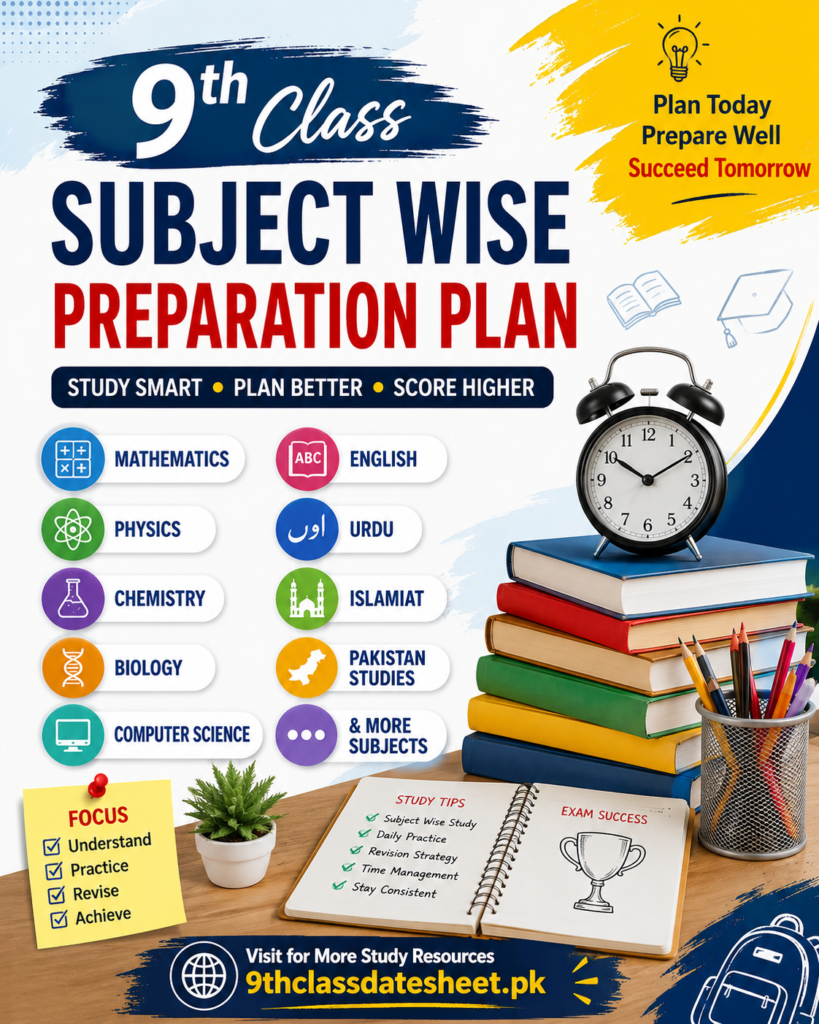
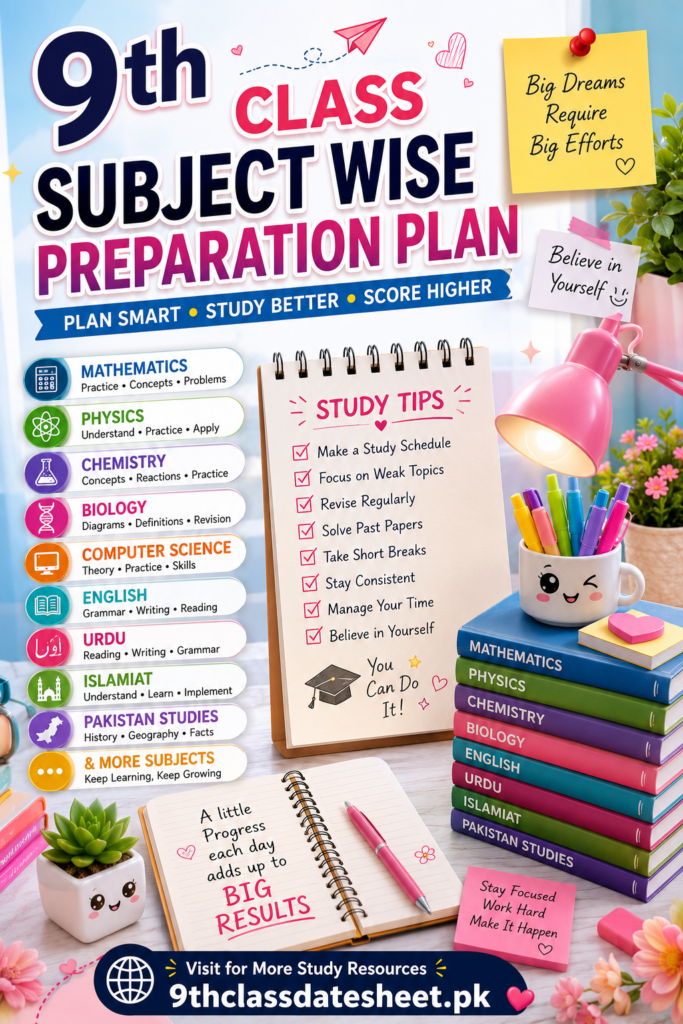
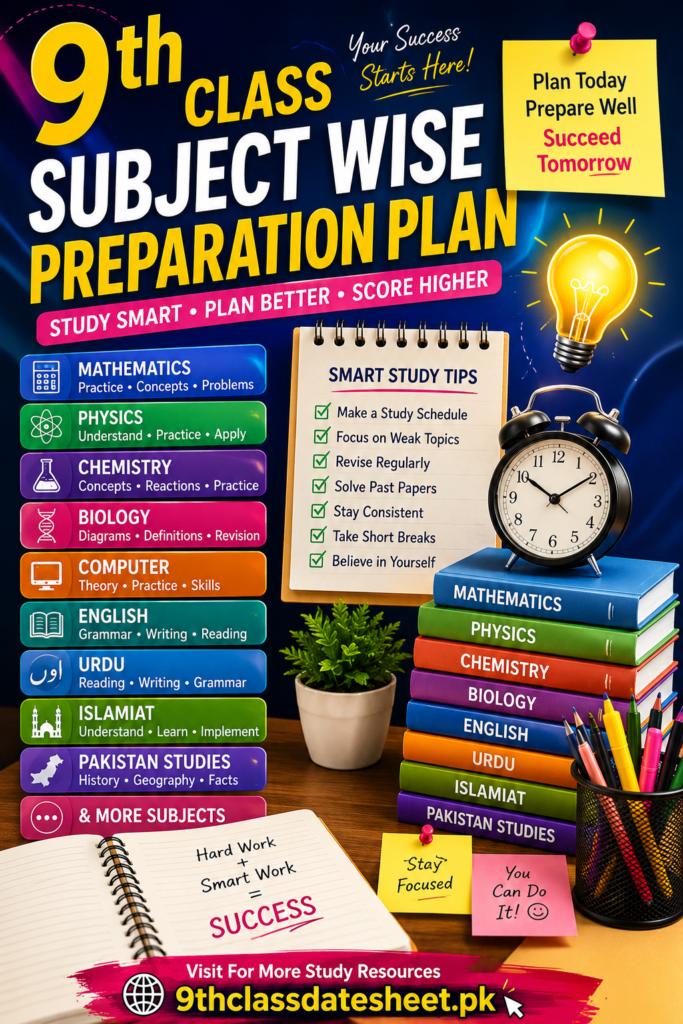
Starting 9th class is an important step in every student’s academic journey. The syllabus becomes more detailed, subjects require greater attention, and students need to develop better study habits to perform well in examinations. A proper 9th Class Subject Wise Preparation Plan can make this process easier by helping students divide their time according to the difficulty and requirements9th Class Subject Wise Preparation Plan.
Many students spend hours studying but still struggle to remember important concepts. The main reason is often a lack of planning. Instead of studying everything at once, students should follow a structured approach that gives every subject enough time for learning, practice, revision, and self-testing.
This guide explains how 9th class students can prepare each major subject effectively and create a balanced 9th Class Subject Wise Preparation Plan.
Why a Subject Wise Preparation Plan Is Important
9th Class Subject Wise Preparation Plan helps students understand where their time should be spent. Every subject has different requirements. Mathematics needs regular problem-solving practice, science subjects require conceptual understanding, languages need reading and writing practice, while theoretical subjects require memorization along with understanding.
Without a proper plan, students may spend too much time on subjects they already understand and leave difficult subjects for the end. This can create unnecessary pressure before 9th Class Subject Wise Preparation Plan.
A good 9th class study plan should therefore include:
- Daily learning time
- Subject-wise revision
- Practice questions
- Previous paper practice
- Short breaks
- Weekly self-tests
- Time for difficult chapters
- Final revision before examinations
The goal is not to study continuously. The goal is to study consistently and effectively.
Mathematics Preparation Plan
Mathematics is one of the subjects that requires regular practice. Reading formulas or solutions without solving questions yourself is not enough. Students should practice mathematics almost every day, even if they have only a limited amount 9th Class Subject Wise Preparation Plan.
Begin by understanding the basic concepts of each chapter. Once you understand the method, solve examples independently. After that, move toward exercise questions and more challenging 9th Class Subject Wise Preparation Plan.
Create a separate notebook for formulas, important rules, and questions that you frequently get wrong. Review this notebook9th Class Subject Wise Preparation Plan.
Recommended Mathematics Routine
A simple mathematics session can be divided into three parts:
- Review the previous lesson.
- Learn or revise the current concept.
- Solve questions without looking at the solution.
If a particular question takes too long, do not immediately memorize its answer. Try to understand where you are making the mistake. Mathematics improves through practice, so consistency is more important than studying for several hours on one day and then ignoring the subject9th Class Subject Wise Preparation Plan.
Physics Preparation Plan
9th Class Subject Wise Preparation Plan become easier when students focus on concepts rather than memorizing complete answers. Before learning formulas, understand what the formula represents and where it is used.
Read each topic carefully and make short notes containing definitions, formulas, units, and important concepts. Numerical problems should be practiced9th Class Subject Wise Preparation Plan.
For numerical questions, follow a clear method:
- Write the given information.
- Identify what needs to be found.
- Select the appropriate formula.
- Substitute the values carefully.
- Check the unit of the final answer.
9th Class Subject Wise Preparation Plan can also be important in physics. Practice drawing relevant diagrams neatly and understand the labels rather than simply copying them.
A useful 9th class physics preparation strategy is to revise formulas several times throughout the month instead of trying to memorize all of them immediately before the 9th Class Subject Wise Preparation Plan.
Chemistry Preparation Plan
9th Class Subject Wise Preparation Plan includes concepts, definitions, formulas, reactions, and scientific terminology. Students should avoid trying to memorize everything without understanding the basic ideas.
Start each chapter by reading the concepts carefully. Highlight important definitions and make concise notes. For reactions and formulas, practice writing them repeatedly until you can reproduce them 9th Class Subject Wise Preparation Plan.
Chemistry preparation can be divided into four areas:
1. Concepts
Understand the basic scientific ideas before memorizing details.
2. Definitions
Prepare short and accurate definitions and revise them regularly.
3. Formulas and Reactions
Create a dedicated revision page for important formulas and chemical reactions.
4. Questions
Practice short questions, long questions, and relevant numerical problems according to your syllabus.
Students should also review mistakes from class tests because repeated mistakes can become a major problem during final 9th Class Subject Wise Preparation Plan.
Biology Preparation Plan
Biology contains many terms, processes, diagrams, and explanations. Students should combine understanding with active 9th Class Subject Wise Preparation Plan.
Read a topic carefully and then close the book. Try to explain the concept in your own words. This method helps you identify which information you 9th Class Subject Wise Preparation Plan.
Diagrams deserve special attention. Practice important diagrams regularly and learn their labels. A neat diagram with correct labeling can make your answer more 9th Class Subject Wise Preparation Plan.
For long questions, avoid memorizing large paragraphs word for word. Instead, understand the sequence of ideas and prepare headings or key points. During revision, use these points to recall the complete explanation.
A 9th class biology study plan should include regular reading, diagram practice, terminology revision, and self-testing.
Computer Science Preparation Plan
9th Class Subject Wise Preparation Plan Science requires both theoretical understanding and familiarity with technical terms. Students should first understand the basic concepts before attempting to memorize definitions.
Create short notes for important terminology, concepts, commands, and differences between related topics. If your syllabus contains programming or practical concepts, practice them instead of only 9th Class Subject Wise Preparation Plan examples.
When preparing theoretical questions, focus on the main idea of the answer. For technical questions, make sure spellings and terminology are accurate.
A useful approach is to revise one small topic at a time and test yourself immediately afterward.
English Preparation Plan
English preparation should cover grammar, vocabulary, reading comprehension, writing skills, and textbook-related material according to the prescribed syllabus.
Students should read English regularly instead of limiting their practice to examination days. Reading helps improve vocabulary and sentence structure.
For grammar, practice questions repeatedly. Keep a list of mistakes and review it every few days.
For writing tasks, practice different formats and learn how to organize your ideas clearly. Do not rely entirely on memorized essays. Understanding structure allows you to adapt your writing to different 9th Class Subject Wise Preparation Plan.
English Daily Practice
Even 30–45 minutes of regular English practice can be useful when divided between:
- Grammar
- Vocabulary
- Reading
- Writing
- Revision
The most important factor is consistency.
Urdu Preparation Plan
Urdu preparation requires attention to reading, writing, grammar, poetry, prose, and other areas included in the syllabus.
Read textbook lessons carefully and understand their meanings. For poetry, focus on explanations, important concepts, and difficult vocabulary. Practice writing answers in clear Urdu.
Students should also revise grammar and writing formats regularly. Instead of waiting until the end of the term, divide the syllabus into smaller sections and revise them throughout the academic year.
Writing practice is particularly useful because knowing an answer is different from being able to present it correctly in an examination.
Islamiat Preparation Plan
Islamiat preparation should focus on understanding the topics as well as remembering important information. Divide chapters into manageable sections and revise them regularly.
Prepare important terms, references, events, personalities, and explanations according to the syllabus. Short questions can be practiced through self-testing.
For longer questions, create headings and key points first. Then practice writing complete answers using those points.
Students should avoid studying the entire subject only during the final days. Regular revision makes it easier to remember information for longer periods.
Pakistan Studies Preparation Plan
Pakistan Studies often includes historical events, important personalities, geographical information, political developments, and other factual material depending on the syllabus.
Use timelines for historical events and short notes for important dates and personalities. When studying a long topic, divide it into smaller headings.
Maps, locations, and geographical concepts should be practiced where required. Students can also create question-and-answer notes for quick revision.
Regular testing is particularly useful for factual subjects because it shows which information needs more revision.
General Science or Additional Subjects
If students have additional subjects, they should not ignore them simply because they carry fewer marks or appear easier. Every subject contributes to the final result.
Assign a fixed amount of time to each additional subject during the week. Focus on understanding the syllabus, preparing important concepts, and practicing questions.
The best approach is to maintain balance rather than giving all study time to one or two subjects.
Create a Weekly 9th Class Study Schedule
After dividing subjects individually, students should combine them into a weekly schedule. A practical timetable should not contain unrealistic study targets.
For example, a student might divide a weekday into several focused sessions:
Session 1: Mathematics practice
Session 2: Science subject
Session 3: Language subject
Session 4: Theoretical subject revision
Short breaks should be included between sessions. Students can adjust the duration according to their school schedule and personal concentration level.
Weekends can be used for revision, practice tests, unfinished chapters, and 9th Class Subject Wise Preparation Plan.
How to Prioritize Difficult Subjects
Not every student struggles with the same subject. One student may find mathematics difficult, while another may need additional help with English or science.
Identify your three most challenging subjects and give them more practice time. However, do not completely ignore your stronger subjects.
A useful method is the 60–30–10 approach:
- 60% of extra study time for difficult subjects
- 30% for average subjects
- 10% for maintaining strong subjects
This does not mean that every student must follow these exact percentages. The idea is simply to give additional attention where it is needed most.
Revision Strategy for 9th Class
Revision should begin from the first month of preparation instead of being treated as a final-stage activity.
Use three levels of revision:
First Revision
Review the chapter after completing it. Make sure you understand the major concepts.
Second Revision
Return to the chapter after several days and test yourself without looking at the textbook.
Final Revision
Before examinations, focus on important concepts, formulas, definitions, diagrams, frequently repeated mistakes, and practice questions.
This repeated-revision method can make information easier to recall.
Practice Previous Examination Papers
Previous papers can help students become familiar with the style and structure of examination questions. They can also reveal areas where students need additional practice.
When solving a paper, set a time limit and try to complete it without checking answers. Afterward, review your mistakes carefully.
Do not focus only on your score. Identify why an answer was wrong. Was the concept unclear? Did you misunderstand the question? Did you make a calculation error? Did you run out of time?
Finding the reason behind mistakes is an important part of exam preparation.
How to Improve Time Management
Time management is one of the most useful skills for 9th class students. A timetable should be realistic enough to follow every day.
Avoid creating a schedule that includes ten or twelve hours of intense study if you cannot maintain it. Start with manageable sessions and gradually increase your study time when necessary.
Keep difficult tasks for periods when you are most focused. Use shorter sessions for revision or memorization.
During examinations, read the complete paper carefully before beginning. Divide your time according to the marks and number of questions.
Common Mistakes Students Should Avoid
Several common habits can make exam preparation more difficult.
Studying only before exams: Last-minute preparation can create stress and leave insufficient time for revision.
Memorizing without understanding: Understanding concepts makes them easier to remember and apply.
Ignoring weak subjects: Difficult subjects require more attention, not less.
Skipping practice: Reading solutions is not the same as solving questions independently.
Using too many resources: Switching between multiple books and notes can create confusion. Follow your prescribed syllabus and reliable study material.
Ignoring sleep: Lack of sleep can negatively affect concentration and learning.
A Simple Daily Routine for 9th Class Students
A balanced daily routine can include school, homework, independent study, revision, exercise, relaxation, and adequate sleep.
After returning from school, take a short break before beginning homework. Complete urgent school tasks first, then move toward focused examination preparation.
Try to study difficult subjects when your concentration is highest. At the end of the day, spend a few minutes reviewing what you learned.
Even a short daily review can help prevent old topics from being forgotten.
Final Month Preparation Plan
The final month should not be used to learn the entire syllabus from scratch. Ideally, most chapters should already have been studied.
During the final month, focus on:
- Complete syllabus revision
- Important questions
- Formulas and definitions
- Diagrams
- Previous papers
- Weak topics
- Timed practice
- Mistake correction
Avoid starting completely new study techniques at the last moment. Continue with the methods that have already worked for you.
Final Thoughts
A successful 9th Class Subject Wise Preparation Plan is based on consistency, organization, and regular revision. Every subject has different requirements, so students should avoid using exactly the same preparation method for all subjects.
Mathematics requires practice, science subjects require conceptual understanding, languages require reading and writing, and theoretical subjects benefit from structured revision and self-testing.
The most effective study plan is not necessarily the longest one. It is the plan that a student can realistically follow every day. Start early, divide the syllabus into manageable portions, give extra attention to difficult subjects, practice regularly, and revise before examinations.
With proper planning and consistent effort, 9th class students can make their preparation more organized and approach their examinations with greater confidence.